
Treaty of Yandabo
The Historic Agreement That Changed the Future of Assam
The Treaty That Marked the Beginning of British Rule
The Treaty of Yandabo, signed on 24 February 1826, officially ended the First Anglo-Burmese War and marked one of the most significant turning points in the history of Assam. The agreement transferred Assam from Burmese occupation to the administration of the British East India Company, ushering in a completely new political, economic, and social era that would shape the region for more than a century.
The Decline of the Ahom Kingdom
By the late eighteenth century, the once-powerful Ahom Kingdom had begun to weaken due to internal conflicts, political instability, and succession disputes. The Moamoria Rebellion significantly reduced the strength of the kingdom and left Assam vulnerable to external invasions. As central authority weakened, different regional leaders struggled for power, creating an unstable political environment that threatened the future of the state.
This period of instability provided an opportunity for the Kingdom of Burma (present-day Myanmar) to expand its influence into Northeast India. Burmese rulers viewed Assam as an important strategic region and launched a series of invasions that would dramatically alter its history.
Burmese Invasions of Assam
Between 1817 and 1824, Burmese forces invaded Assam several times. These invasions caused widespread destruction across towns and villages. Agricultural lands were abandoned, trade routes collapsed, and thousands of people were displaced from their homes. Historical records describe this period as one of great suffering for the people of Assam.
The repeated invasions weakened the remaining authority of the Ahom rulers. Many local leaders sought outside assistance to restore stability, while ordinary citizens faced famine, violence, and economic hardship.
The First Anglo-Burmese War
The expansion of Burmese influence eventually alarmed the British East India Company. Concerned about the security of its eastern territories and growing Burmese power, the Company declared war on Burma in 1824. This conflict became known as the First Anglo-Burmese War (1824–1826).
The war was fought across several regions, including Assam, Manipur, Arakan, and parts of present-day Myanmar. Although the campaign proved difficult and costly, British forces gradually gained the upper hand and advanced toward the Burmese capital.

The Signing of the Treaty of Yandabo
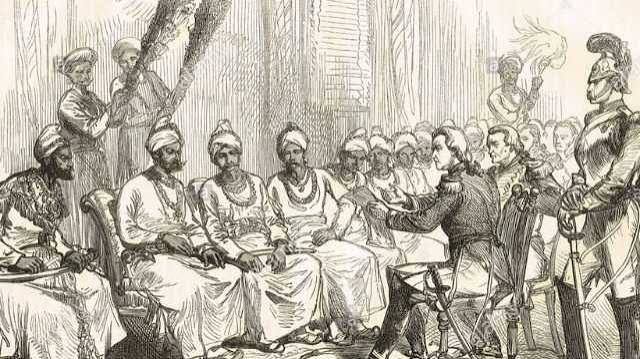
On 24 February 1826, representatives of the British East India Company and the Burmese Kingdom signed the Treaty of Yandabo in the village of Yandabo in present-day Myanmar. The treaty officially ended the First Anglo-Burmese War and established new political boundaries in the region.
Under the agreement, Burma agreed to withdraw from Assam, Manipur, Arakan, and several neighboring territories. The British East India Company assumed administrative control over Assam, bringing the region under British colonial rule.
Major Terms of the Treaty
The Treaty of Yandabo contained several important provisions. Burma recognized British authority over Assam and neighboring territories, agreed to pay a large financial indemnity, released prisoners of war, and accepted diplomatic relations with the British government. These terms significantly reduced Burmese influence in Northeast India while strengthening British political control.
For Assam, the treaty marked the end of Burmese occupation but also the beginning of a new colonial administration that would influence every aspect of life for the next 120 years.
The Beginning of British Administration
Following the treaty, the British East India Company reorganized the administration of Assam. New systems of governance, taxation, law, and revenue collection were introduced. British officials established administrative headquarters and gradually integrated Assam into the colonial structure of British India.
Roads, postal services, educational institutions, and later railway networks improved communication and connected Assam with other regions of India. These developments modernized parts of the state but were primarily designed to support colonial administration and trade.
Growth of the Tea Industry
One of the most significant developments during British rule was the establishment of the commercial tea industry. After discovering that indigenous tea plants grew naturally in Assam, British entrepreneurs established large tea plantations across the Brahmaputra Valley.
Assam soon became one of the world's leading tea-producing regions. The tea industry created employment and transformed the state's economy, although plantation workers often faced difficult working conditions under colonial management.
Economic and Social Changes
British rule introduced important changes in education, transportation, administration, and commerce. Modern schools, government institutions, bridges, and roads gradually developed across the region. English education opened new opportunities for many Assamese people and contributed to the emergence of a modern educated society.
However, colonial policies also emphasized the extraction of natural resources for the benefit of the British Empire. Revenue systems, land policies, and commercial agriculture changed traditional economic structures and affected local communities in different ways.
Historical Importance
The Treaty of Yandabo represents one of the most important milestones in Assam's history because it marked the transition from the centuries-old Ahom Kingdom to British colonial administration. It ended Burmese occupation, introduced modern administrative systems, and connected Assam more closely with the rest of British India.
Although colonial rule brought significant economic and infrastructural development, it also introduced political control, economic exploitation, and social transformation that influenced Assam for generations.
Legacy of the Treaty
Today, historians regard the Treaty of Yandabo as one of the defining events in the history of Northeast India. It changed the political future of Assam, reshaped regional power in South Asia, and laid the foundation for many developments that followed during the colonial period.
Understanding the Treaty of Yandabo helps explain the transition from the Ahom era to modern Assam. Its influence can still be seen in the state's administrative institutions, economic history, transportation networks, tea industry, and educational development. More than two centuries later, the treaty remains a key chapter in the journey through the history of Assam, illustrating how a single diplomatic agreement transformed the destiny of an entire region.
Historical Gallery
Explore the places, documents, and historical events connected with the Treaty of Yandabo and the beginning of British rule in Assam.
Treaty of Yandabo
British Administration
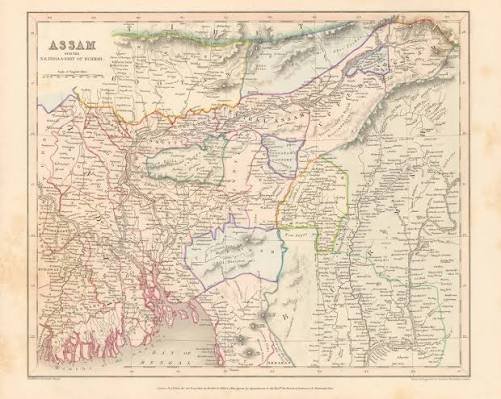
Historical Map of Assam
"The Treaty of Yandabo marked the end of one era and the beginning of another, reshaping the history of Assam forever."
— Historical significance of the Treaty of Yandabo (1826)